Oil Palm Fruit Harvesting Machines: Reach, Access and Stability Matter More Than Size
Engineering considerations for crawler-type harvesting equipment in plantation environments
The performance of an oil palm fruit harvesting machine should not be evaluated by machine size or maximum boom reach alone. In plantation environments, its practical value depends on the relationship between three engineering factors: working reach, terrain accessibility and operational stability.
Oil palm plantations present a distinctive set of operating conditions. Machines must work around regularly spaced trees, navigate restricted field passages, accommodate variations in ground elevation and operate on soils that may become soft or waterlogged. These conditions make equipment selection more complex than simply choosing a machine with greater lifting capacity or a longer boom.
For modern crawler-type harvesting machines, the central design challenge is to achieve sufficient working coverage while maintaining mobility and stability in the field.
Unlike conventional construction sites, oil palm plantations are structured agricultural environments. Tree spacing, planting patterns, field roads, drainage systems and ground conditions all influence machinery deployment.
The harvesting process also involves repeated movement between working positions. A machine may need to approach a palm, position its harvesting attachment, complete the operation and relocate to the next working area. Its efficiency therefore depends not only on the speed of the harvesting mechanism, but also on how effectively it moves and repositions within the plantation.
Research into mechanised oil palm harvesting has identified terrain, transportation distance and machine manoeuvrability as important factors affecting field operations. In particular, conventional tractor-based systems can face limitations on uneven terrain and in areas with poor soil conditions.
This means that plantation machinery should be designed around the actual field environment rather than evaluated solely by conventional excavator performance indicators.
A telescopic boom provides an important advantage in plantation harvesting: it allows the working attachment to reach positions that may not be directly accessible from the machine's location.
However, maximum reach is only one part of the working envelope. The machine must also position the harvesting attachment at an appropriate height and angle, maintain sufficient control during extension and retraction, and accommodate differences in palm height and surrounding vegetation.
An excessively long working reach may increase the structural and stability demands placed on the machine. As the boom extends, the distance between the attachment and the machine's supporting structure increases. This changes the load moment and places greater demands on the boom, hydraulic system and undercarriage.
The design objective is therefore not to maximise reach without limitation. It is to provide an effective working envelope that corresponds to the physical characteristics of the plantation.
For equipment selection, buyers should consider the average palm height, the distribution of trees, the required attachment position and the available operating space. These factors provide a more meaningful basis for determining boom configuration than maximum reach alone.
The undercarriage is fundamental to the mobility of a harvesting machine.
In oil palm plantations, working surfaces may range from compacted field roads to uneven, sloping or moisture-sensitive ground. Conventional wheeled equipment can be restricted where traction and ground support are insufficient.
A crawler undercarriage provides a continuous track contact surface and distributes machine weight over a larger area than a comparable wheel contact arrangement. This can improve traction and mobility on certain unpaved and uneven surfaces.
Nevertheless, crawler mobility should not be confused with unrestricted terrain capability.
Actual performance depends on machine weight, track geometry, soil bearing capacity, ground moisture and operating technique. On soft soil, excessive ground pressure may still cause sinkage. Repeated turning can also disturb the surface and contribute to soil compaction.
A crawler-type harvesting machine should therefore be evaluated as part of the plantation's broader field management system. Its suitability depends on whether the undercarriage can travel across the intended working areas without causing unacceptable ground disturbance.
Reach and mobility are useful only when the machine can operate with adequate stability.
When a telescopic boom extends, the combined weight of the boom and attachment acts at a greater distance from the machine's centre of support. This creates an increased overturning moment. The effect becomes more significant when the machine is positioned on uneven ground or when the working attachment is carrying additional loads.
Several structural and operating factors influence stability:
· The width and effective support area of the undercarriage.
· The distribution of machine weight and the position of the centre of gravity.
· The structural strength of the boom and its connection points.
· Hydraulic control during boom extension and attachment movement.
· Ground bearing capacity and the slope of the operating surface.
These factors should be considered as a combined system. A longer boom cannot compensate for inadequate undercarriage support, just as a wider crawler base cannot eliminate the risks associated with unsuitable ground conditions.
It is also important to distinguish between travelling stability and working stability. A machine may travel successfully across a particular surface but still require stricter operating limits when its boom is fully extended.
Manufacturers should therefore provide appropriate operating instructions and stability limitations for different working configurations. Operators should follow these limits rather than relying on visual judgement alone.
In plantation operations, physical dimensions influence how efficiently a machine can be deployed.
Restricted access between tree rows, narrow field roads, drainage channels and vegetation can limit the movement of large equipment. A machine with a compact overall configuration may be easier to transport, position and relocate within these areas.
However, compactness involves engineering trade-offs. Reducing the overall dimensions of a machine can affect the available support area, counterweight arrangement, component layout and working envelope. These aspects must be addressed during the design process.
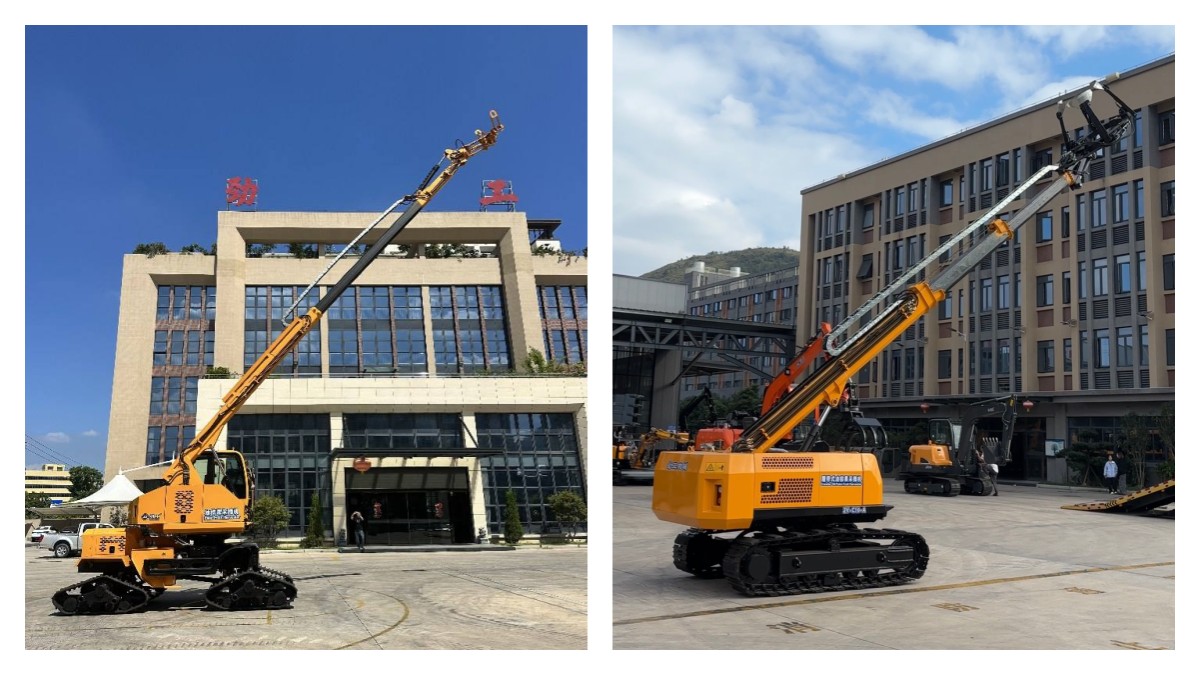
The latest crawler-type harvesting machine developed by Jinggong reflects this design direction: integrating the harvesting boom with a crawler-based platform to address the mobility and access requirements of plantation work.
The important consideration is not simply whether the machine is smaller, but whether its overall structure provides an appropriate balance between transportability, field manoeuvrability and working stability.
A well-designed compact machine should be able to access the intended working area while retaining sufficient structural support for its harvesting operations.
Mechanical harvesting should not be considered as an isolated process.
In practice, plantation productivity is influenced by several connected operations: machine movement, attachment positioning, bunch cutting, collection of harvested bunches and subsequent transportation to collection points.
These activities may involve different machines and working systems. A harvesting machine designed to position a cutting attachment does not necessarily replace the equipment required for loose-fruit collection or fresh fruit bunch evacuation.
This distinction is important when evaluating the expected productivity of a harvesting machine. Its performance should be considered in relation to the complete plantation workflow, including the distance between palms, field access routes, collection arrangements and the availability of downstream transportation equipment.
A machine may complete the harvesting operation efficiently, but overall productivity can still be limited by slow collection or transportation.
Before selecting a crawler-type oil palm harvesting machine, plantation operators should assess the following conditions:
|
Selection factor |
Information to confirm |
|
Plantation structure |
Tree height, planting density, row spacing and the distribution of mature palms. |
|
Terrain characteristics |
Ground firmness, soil moisture, slope variation, drainage and soft or unstable areas. |
|
Access conditions |
Field-road width, turning space, vegetation clearance and transportation restrictions. |
|
Working requirements |
Required harvesting height, attachment configuration, working radius and frequency of relocation. |
|
Operational management |
Operator training, maintenance arrangements, harvesting workflow and fruit evacuation. |
What is the most important specification for an oil palm harvesting machine?
There is no single specification that determines suitability. Working reach, plantation access, undercarriage performance and stability must be evaluated together. The correct balance depends on palm height, row spacing, terrain and the harvesting method.
Why are crawler undercarriages useful in oil palm plantations?
Crawler tracks can provide a larger continuous ground-contact area and useful traction on suitable unpaved or uneven surfaces. They do not, however, make a machine suitable for every soft soil or slope condition. Ground bearing capacity and operating limits remain important.
Does a longer boom always make an oil palm harvester better?
No. A longer boom can increase the working envelope, but it also increases structural and stability demands as the boom extends. The useful reach is the reach that can be operated accurately and stably under the plantation's actual conditions.
Why is machine width important in a plantation?
Plantation roads, tree rows and drainage structures can restrict machine movement. A suitable overall width helps the machine reach more working areas and reduces the need for excessive road or field modification.
Can one harvesting machine handle the entire oil palm harvesting process?
Not necessarily. Cutting or harvesting fruit bunches, collecting loose fruits and transporting harvested bunches are different operations. Overall plantation productivity depends on how these stages are connected into one workflow.
What information should a buyer provide when requesting a harvesting machine?
Useful information includes average and maximum palm height, row spacing, field-road width, soil and slope conditions, required harvesting method, attachment type, transport restrictions and the expected daily operating environment.
The development of oil palm fruit harvesting machinery is not simply a process of increasing boom length or machine capacity. It requires the integration of working range, crawler mobility, structural support and operational stability.
In plantation environments, these characteristics are closely connected. A longer boom may expand the working envelope but increase stability demands. A crawler undercarriage may improve mobility on suitable uneven surfaces, but its performance remains dependent on soil conditions and machine weight. A compact structure may simplify access, but it must retain adequate support for extended-boom operation.
The most effective harvesting machine is therefore not necessarily the largest or most powerful one. It is the machine whose working range, undercarriage design and stability characteristics are properly matched to the plantation environment.
As plantation mechanisation continues to develop, equipment design should increasingly focus on the relationship between machine capability and field conditions. This approach provides a more reliable basis for improving operational efficiency while maintaining the long-term condition of plantation land.
1. Malaysian Palm Oil Board (MPOB), Impact of Mechanisation on Soil Compaction in Oil Palm Plantations.
2. Malaysian Palm Oil Board (MPOB), Enhancing Field Mechanisation in Oil Palm Management.
3. Journal of Oil Palm Research, Mechanising Oil Palm Loose Fruits Collection – A Review.
No. 88 Pancuo, Jiaonan Village, HeShi Town, Luojiang District, Quanzhou, Fujian, China
tel : +8618805957336
WhatsApp : +8618805957336
o email : winny@fjjgjx.com
 rede ipv6 suportada
digitalizar para wechat :

 tel : +8618805957336
 o email : winny@fjjgjx.com


 Mapa do site